






The following extract is from SportBusiness’ Global Media Report 2025. To find out more about the report, head to the SportBusiness website.
The global value of sports media rights stands at slightly under $58bn in 2025.
That is below last year’s value, due to 2024 including both the Olympic Games and the Uefa European Championship.
Perhaps the best comparison is with 2023, when the total value came in at slightly under $56bn, showing a stable if unspectacular 3.3 per cent growth in 2025 compared to that year.
However, the projection for 2026 – a Fifa World Cup year – is $66.42bn. Compared to 2024, this would constitute an increase of 6.2 per cent. The direction of travel for global sports media rights, therefore, is still broadly ‘up and to the right’.

This would suggest there should be a pause in pronouncements on the decreasing value of sports media rights, driven by changes in consumer behaviour and global media consumption.
Well, yes and no.
There are top-tier properties which have seen and will likely continue to see no drop off. One thinks of course of the number one property – “The NFL always wins” – but also the likes of the Indian Premier League. From 2026 we’ll see the NBA leapfrog the English Premier League into second place due to its new $76bn, 11-year domestic media rights deals with Disney, Comcast and Amazon.
The Premier League is an intriguing case. Internationally, it’s boom time. Domestically, however, it could be a challenge to eke out further growth when it next takes it rights to market, for the 2029-30 season onwards.

More broadly, though, there does seem to be a pattern. The marquee sports properties are continuing to maximise monetisation of their media rights. Middle- and lower-tier properties are finding the new landscape more challenging.
This also applies to territories, where those with stronger media ecosystems are taking a greater share of the overall pie. The top ten markets make up 83.7 per cent of the total value of global sports media rights. This is up from last year’s 80 per cent.
The US has grown its dominance, and now holds over half the value, with 50.1 per cent of the overall share.
Perhaps reflecting broader macroeconomic trends, the US is widening the gap with Europe. The UK remains the second biggest media rights market in the world, though its growth remains mediocre. Its projected compound annual growth rate from 2021-28 is 2.5 per cent.

Meanwhile Spain, Germany, Italy and France each hold between three and four per cent of the global total. Growth, however, looks hard to come by, beyond marquee global events.
France, in particular, is struggling. It is still in the top ten for now, but the direction of travel is not encouraging. France’s CAGR from 2021-28 is minus 1.2 per cent. Indeed, perhaps the most significant media rights story over the past year has been Ligue 1 launching its Ligue 1+ in-house channel following the collapse of its five-year deal with DAZN after just one season.

In terms of sports, the two football categories (‘soccer’ and American) together make up 58 per cent of global sports media rights.
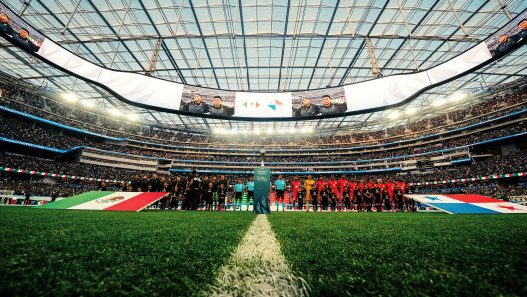
The past year saw Fifa’s extended version of the Club World Cup take centre stage, dominating the football conversation from the political to the commercial. Fifa will be at the fore next year as well, when the World Cup will help propel football’s media rights revenues to over $24bn.
Head here to learn more about the Global Media Rights Report 2025.